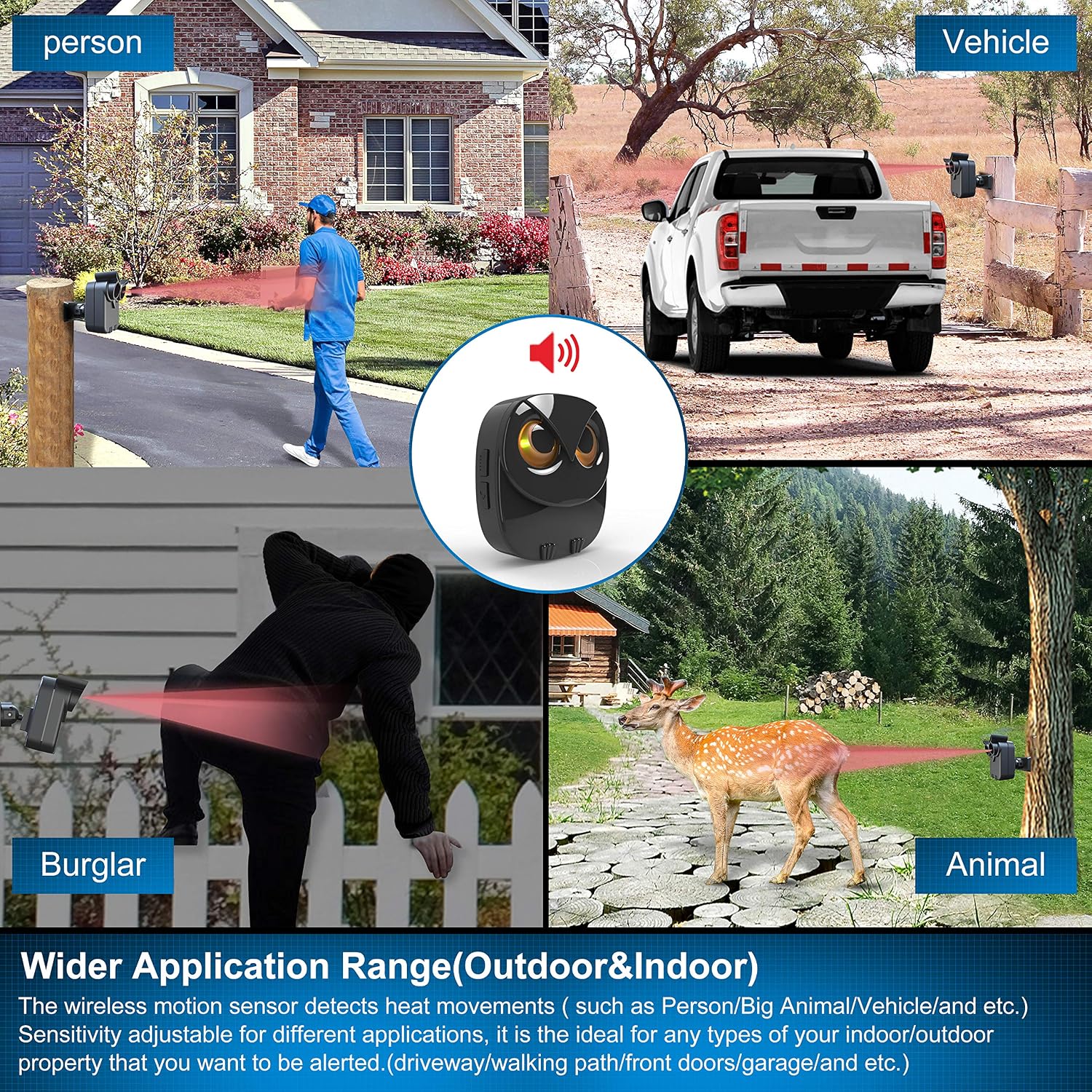
A driveway alarm is exactly what it sounds like: a sensor system that alerts you the moment something — a car, a person, a delivery truck — crosses into your driveway or property boundary. The sensor sits outside, the receiver sits inside, and a chime or alert fires the instant detection happens. Simple in concept, but the real challenge is calibration: you want to catch every human visitor and every approaching vehicle while filtering out the squirrel that crosses your driveway seventeen times a day. Getting that balance right is what separates a system you trust from a system you eventually unplug. In this guide we’ll walk through the main detection technologies, the range and sensitivity tradeoffs that matter most, how these sensors plug into broader alarm ecosystems, and a clear decision framework so you can match hardware to your specific property layout and threat model.
| EDITOR'S PICKDriveway Alarm- 1/2 Mile Long R… | Mid-tierDriveway Alarm Wireless Outside | Budget pick[EDISHINE Motion Sensor](https://www.amazon.com/dp/B0B5QZCV2D?tag=greenflower20-20) | |
|---|---|---|---|
| Range | 0.5 miles | 1000 ft | 60 ft |
| Sensors included | 1 sensor | 2 sensors | 1 sensor |
| Weatherproof | ✓ | — | — |
| Receiver included | ✓ | ✓ | ✗ |
| Price | $37.99 | $26.99 | $11.99 |
| See on Amazon → | See on Amazon → | See on Amazon → |
Detection Technology: Passive Infrared, Magnetic, and Laser/Break-Beam — What Each One Actually Does
The sensor type is the most consequential choice you’ll make. Every other spec — range, frequency, battery life — flows downstream from this decision.
Passive Infrared (PIR) is the default technology in most consumer-grade driveway alarms. PIR sensors detect the infrared heat signature emitted by warm bodies moving through the detection zone. They don’t emit anything; they just “listen” for heat differentials. That passivity is a feature — it means low power draw and low cost. The tradeoff: PIR sensors see heat, not shape, so a large dog, a deer crossing at close range, or a sudden temperature swing from direct afternoon sun can all register as hits. Published guidance from SafeWise’s 2025 driveway alarm buying guide highlights this as the primary complaint in long-run reviews: PIR sensors work well in shaded, temperate environments and degrade meaningfully in high-ambient-heat or wildlife-heavy settings.
Magnetic vehicle sensors take a fundamentally different approach. A buried or surface-mounted probe detects the electromagnetic mass of a vehicle’s metal body. They trigger on cars, trucks, and motorcycles with extremely high specificity — a human walking by won’t register because humans don’t carry enough ferrous mass. The Spruce’s 2025 driveway alarm overview notes that magnetic sensors are the preferred choice for users who exclusively want vehicle detection and want to eliminate pedestrian false positives entirely. The downside: installation is more involved (typically a ground-mounted or driveway-embedded probe), and they won’t help you detect a person approaching on foot.
Break-beam sensors (also called active infrared or laser beam detectors) work by projecting a beam across a defined gap — usually between a transmitter post and a receiver post straddling a driveway entry. When the beam breaks, the alarm fires. These are highly accurate for entry-point detection because they require a physical interruption of the beam, not just a heat signature. According to Security Info Watch’s 2024 perimeter detection technology coverage, break-beam systems are common in commercial perimeter setups and increasingly accessible to the residential prosumer market. The tradeoff: they require two installed points aligned precisely, making them better suited for defined choke points (a gate, a driveway entrance) than wide-open field monitoring.
Dual-technology sensors — PIR plus microwave radar in a single housing — are the practitioner’s choice when false alert tolerance is low. Both technologies must trip simultaneously before an alert fires, which dramatically reduces nuisance triggers. PCMag’s 2025 driveway alarm review section consistently notes that dual-tech units show up in reviews when users are on their second or third sensor after getting frustrated with false positives from a pure-PIR starter unit.
Range, Frequency, and Environmental Variables: The Numbers That Actually Matter
By the numbers: — PIR driveway sensors: typical effective range 30–100 ft; some long-range models rated to 500 ft under ideal conditions — 433 MHz RF band: common in consumer kits; moderate wall/obstacle penetration, range up to ~300 ft open-air — 900 MHz RF band: better range and obstacle penetration than 433 MHz; less crowded spectrum — Magnetic vehicle sensor probe cable: standard 50–100 ft cable runs to receiver, extensible with add-on cable
Published specs from the Alarm Grid driveway alarm guidance page show that “long-range” marketing language on consumer PIR units almost always refers to open-air, line-of-sight conditions with no obstructions and a calibration optimized for vehicle-sized targets. Real-world installations cut that spec by 30–50% once you factor in trees, fencing, grade changes, and seasonal foliage. When a manufacturer rates a sensor at 500 ft, budget for reliable detection at 250–300 ft in a typical wooded or suburban installation.
Frequency matters because the sensor and receiver communicate wirelessly. The 433 MHz band is crowded — your neighbors’ garage door openers, temperature sensors, and key fobs all compete on it. In dense neighborhoods, interference can cause phantom alerts. The 900 MHz band (used by DECT cordless phones and some Z-Wave devices) has better propagation through walls and is less congested. If you’re evaluating systems for a property where the receiver needs to sit two rooms deep into the house, the frequency spec is worth checking before you commit.
For integrators speccing a driveway alarm into a DSC PowerSeries Neo or Qolsys IQ Panel 4 ecosystem, the cleanest path is a wired normally-closed (NC) or normally-open (NO) relay output from the driveway sensor into a hardwired zone on the panel. This bypasses RF entirely. Alarm Grid’s documentation on auxiliary input zones covers this wiring pattern for most mid-tier panels. The Napco Starlink communicator ecosystem, for example, can receive a relay trigger from a driveway sensor and push it as a named zone alert through a cellular path — useful for remote properties where the owner isn’t on-site.
False Alert Reduction: Where Most Buyers Get It Wrong
False alerts are the #1 reason driveway alarms get unplugged. The failure mode is almost always the same: someone buys a single-technology PIR unit, installs it at the recommended height, and within 48 hours the chime is going off six times an hour because of ambient movement, and the system gets disabled. The practical guidance from long-run owner reviews — aggregated across both PCMag’s evaluation methodology and SafeWise’s reader survey data — points to several patterns:
Aim matters more than sensitivity dial position. PIR sensors detect heat moving across their field of view, not directly toward them. Mounting a sensor so that traffic crosses the detection beam laterally (e.g., sensor aimed perpendicular to the driveway lane, not down the lane from the end) produces more reliable triggering and fewer edge-case misses. Mounting it to stare straight down a long driveway from the far end creates a small target profile for approaching objects.
Height calibration filters animal traffic. Most deer-country installations that consistently report false positives are mounted at 24–30 inches — the exact height profile of a medium-to-large dog or deer. Raising the sensor to 36–48 inches on the mounting post moves the detection zone’s lower edge above most wildlife while still catching vehicle rooftops and human torsos. The Spruce’s installation guidance for residential driveway sensors specifically flags this as the single easiest false-positive fix.
Sensitivity zones in dual-tech sensors are adjustable. If you’re installing a PIR/microwave dual-tech unit, don’t assume the factory defaults are calibrated for your property. Published installation documentation for most commercial-grade dual-tech sensors includes separate PIR and microwave sensitivity dials. Operators who invest 15 minutes setting these to match their specific detection-zone geometry report significantly fewer nuisance trips than plug-and-go installations, according to Security Info Watch’s 2024 perimeter detection coverage.
Seasonal recalibration is real. A sensor installed in February with bare trees will behave differently in July when foliage fills the detection zone, heat shimmer off pavement increases, and ambient animal activity spikes. Budget for one calibration pass per season on any PIR-based system.
Integration Paths: Standalone vs. Panel-Connected vs. Smart Home Node
This is where the decision tree branches for practitioner buyers.
Standalone consumer kits (Guardline, Dakota Alert, Mighty Mule) are the right call for a property owner who wants a chime in the house when the driveway sensor fires — full stop. No app, no panel integration, no configuration beyond mounting and pairing. SafeWise’s 2025 buying guide identifies this segment as the highest-volume driveway alarm category. The tradeoff: you get no logging, no remote notification without an add-on accessory, and no zone labeling in a multi-sensor setup.
Panel-connected zones are the practitioner’s path. A relay-output driveway sensor wired into a Honeywell Vista-20P, DSC Neo, or Qolsys IQ Panel 4 as a perimeter zone gives you everything the panel can do: zone naming, arming schedules, central station reporting, cellular backup, and event logs. The sensor appears in the panel’s zone list the same as any door or window contact. For property managers running multiple units, this integration means driveway events show up in the same monitoring stream as all other security events.
Smart home / Home Assistant integration is growing in this segment. Several driveway sensor brands now publish Z-Wave or Zigbee variants that pair directly into a Home Assistant hub or SmartThings bridge. Alarm Grid’s documentation notes that the clean integration path for HA-based setups is typically a Z-Wave motion sensor at the driveway wired into an automation rule — though the latency and reliability of smart-home bridges varies by platform in ways that a dedicated panel zone does not.
Decision Framework: If X, Then Y
If your only goal is knowing when a vehicle enters a single driveway and wildlife false positives are acceptable, a mid-range consumer PIR kit in the $40–$120 range covers the use case cleanly.
If vehicle-only detection is the priority and you want near-zero false positives, spec a magnetic vehicle sensor. Accept the more involved installation and the limitation that foot traffic won’t register.
If you’re integrating into a DSC, Honeywell, or Qolsys panel, buy a sensor with a dry-contact relay output and wire it as a hardwired zone. This gives you panel-native event logging and central station visibility with no protocol translation layer.
If the property has significant wildlife pressure, high ambient heat, or dense foliage, move directly to a dual-technology (PIR + microwave) sensor rather than iterating through single-tech units. The upfront cost difference — typically $80–$200 more — is recovered in the first week you don’t unplug the thing.
If you’re building a multi-zone perimeter across a large rural property with a long driveway and a detached structure, treat the driveway alarm as one zone in a panel-based design, not a standalone product — and choose a panel with enough hardwired zone capacity to absorb it cleanly alongside door/window and interior motion zones.
The right driveway alarm isn’t the one with the longest advertised range. It’s the one that matches your detection target (vehicle vs. human vs. both), your installation environment, and your tolerance for configuration work — and that reliably stays enabled because it isn’t crying wolf.