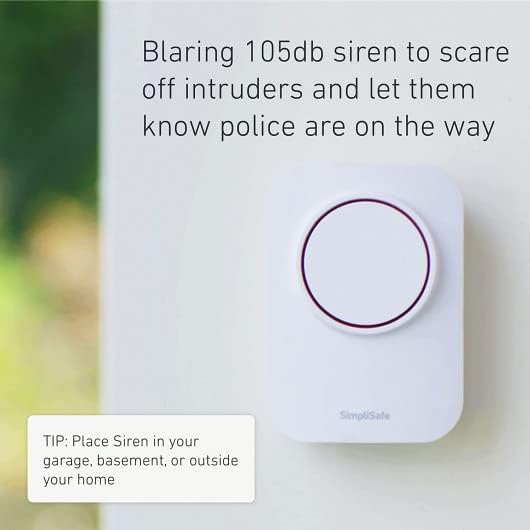
An outdoor siren — the weatherproof speaker box mounted on your home’s exterior wall — is one of the most visually and acoustically effective parts of a residential alarm system. Its job is two-fold: alert the neighborhood that something is wrong, and make an intruder want to leave immediately. Unlike a quiet internal alert to a monitoring center, a 110-decibel horn at head height is hard to ignore. Yet outdoor sirens are also one of the most under-specified components in DIY and prosumer builds. Buyers often bolt on whatever the panel manufacturer bundles, without asking whether it actually serves the property’s layout, power availability, or local noise ordinance. This guide breaks down the three main categories — hardwired, wireless, and solar-assisted — rates them on deterrence, installation complexity, and long-term reliability, and gives you a clear decision framework at the end.
Why Outdoor Siren Placement and Power Architecture Matter More Than Brand
Before ranking siren types, it’s worth framing what “real-world deterrence” actually means in spec terms. Most security practitioners default to dB (decibel) output as the proxy metric — and it matters, but it’s one variable among several.
The deterrence stack, in order of impact:
- Visual presence — A siren strobe and enclosure on the roofline communicates “this property has a monitored system” before any alarm fires. Per SafeWise’s overview of home security components, visible deterrents reduce opportunistic break-in attempts independent of whether the system is armed.
- Acoustic output at street distance — A siren rated at 110 dB measured at 1 meter drops to roughly 80 dB at 30 feet due to inverse-square law attenuation. SDM Magazine’s 2025 residential alarm peripheral update notes that installers increasingly spec dual-tone or variable-frequency sirens because they’re harder for neighbors to habituate to and ignore.
- Tamper resistance and backup power — A siren that silences when a burglar cuts power or defeats the panel is worse than no siren. This is where the wired-vs-wireless-vs-solar decision becomes structural.
- Loop supervision — Whether the panel knows the siren has been cut or disconnected. A supervised output is a non-negotiable for any serious install.
PCMag’s comparative review of home security accessories consistently highlights that budget wireless sirens — particularly those relying solely on battery — show the highest rate of “siren didn’t activate” complaints in aggregated user feedback, typically tracing back to dead batteries or RF interference at activation time.
Wired Sirens: The Workhorse Choice for Hardwired Panel Builds
Wired outdoor sirens — powered via a direct run from your alarm panel’s auxiliary power output or a dedicated bell output — remain the benchmark for reliability in any Honeywell Vista-20P, DSC PowerSeries Neo, Bosch Solution 6000, or Qolsys IQ Panel 4 installation where conduit or cable chase access exists.
How they work: The panel supplies 12V DC to the siren enclosure. Activation triggers the bell output, driving the siren and strobe. Most panels can supervise the bell circuit, meaning a cut wire or shorted terminal generates a trouble condition.
Real-world tradeoffs:
- Reliability ceiling is high. Alarm Grid’s installation and compatibility documentation notes that hardwired bells powered from the panel’s battery-backed auxiliary output will continue to activate even through a mains power outage — as long as the panel battery holds (typically 4–24 hours depending on battery size and load).
- Installation cost is the main friction point. Running 18/4 or 22/4 cable from the panel to an exterior mounting location — especially on a two-story home or brick facade — can add 2–4 hours of labor on a retrofit job. On new construction or gut renovations, it’s the obvious choice.
- Enclosure IP rating matters. Specify IP54 minimum for protected soffits; IP65 or IP66 for fully exposed gable mounts. Manufacturers often publish two models in the same enclosure family at different IP ratings — verify the spec sheet, not the product photo.
- Who should skip this: Renters, apartment dwellers, or anyone on a no-drill lease. Also not practical as a standalone peripheral for a wireless-native system like Ring Alarm or SimpliSafe without an auxiliary power adaptor and additional hardware.
By the numbers — wired siren benchmarks (published specs, aggregated from manufacturer datasheets):
| Metric | Typical Range |
|---|---|
| Acoustic output | 108–120 dB @ 1m |
| Operating voltage | 10.5–14V DC |
| Current draw (active) | 250–500 mA |
| IP rating | IP54–IP66 |
| Expected service life | 10–15 years |
Wireless Sirens: Right Tool for Wireless-Native Systems, Wrong Tool When Misapplied
Wireless outdoor sirens communicate with the panel via RF (radio frequency) — typically at 319.5 MHz, 345 MHz, or 433 MHz depending on the panel ecosystem — and run on internal battery packs or a combination of mains power with RF communication.
The honest assessment: wireless sirens are an excellent fit for wireless-native panels (Ring Alarm Pro, Abode Iota, SimpliSafe) and for retrofits where running cable is genuinely impractical. They are a mediocre fit when installers reach for them simply to avoid pull wire on a hardwired-capable install.
Strengths:
- Installation speed. A wireless siren on a compatible panel can be enrolled and mounted in under an hour with basic tools. For property managers turning over units or installers doing high-volume residential work, that labor delta is real money.
- Ecosystem integration. Ring’s outdoor siren, for example, integrates natively with Ring Alarm Pro’s Z-Wave and Ring device network, enabling strobe-only activation, duration control, and remote testing from the app — features a dumb bell output doesn’t offer.
- No cable vulnerability. There’s no bell wire to cut at the panel end — though the siren enclosure itself is still a physical tamper target.
Weaknesses:
- Battery dependency is a legitimate risk. Security Info Watch’s 2024 outdoor notification device trends report flags battery failure as the leading cause of wireless siren non-activation in post-incident reviews. Owners consistently report that low-battery alerts in app don’t always translate to timely battery replacement in practice.
- RF supervision windows. Most wireless sirens check in with the panel on a supervision interval (commonly 60 minutes or 24 hours depending on manufacturer). A defeat attempt that jams the RF signal during that window may not generate an immediate trouble alert. On prosumer platforms like Qolsys IQ Panel 4, the supervision interval is configurable — tighten it for higher-security applications.
- Who should skip this: Anyone running a hardwired panel with available bell output and reasonable cable access. The added complexity of battery management and RF enrollment is rarely worth it when you have a 12V wire path available.
Solar-Assisted Sirens: Genuine Use Case, Overhyped Marketing
Solar outdoor sirens — enclosures with a small integrated photovoltaic panel that trickle-charges an internal battery — have moved from niche curiosity to a legitimate product category over the past three years. They occupy a specific sweet spot: locations with no mains power access, no conduit path back to a panel, and adequate sun exposure.
The key word is “assisted.” Solar panels on siren enclosures are supplemental charging sources, not primary power systems. The acoustic load of a siren activation — sustained 110 dB output drawing 300–500 mA — depletes even a healthy internal battery in 20–30 minutes. The solar panel’s job is to keep that battery topped between events, not to power a siren through a prolonged activation.
Where solar sirens make genuine sense:
- Detached garages, outbuildings, or perimeter gates where running cable is cost-prohibitive
- Properties with frequent short-duration activations (test events, false alarms) where battery cycling is the primary wear mechanism
- Supplemental deterrence nodes at the outer perimeter of a larger hardwired system — extending acoustic coverage without extending the main cable run
Where the marketing outpaces the reality:
- North-facing or heavily shaded mounting locations. A solar siren mounted under a deep soffit on the north wall of a home in the Pacific Northwest is functionally a battery siren with a decorative panel. Published specs from multiple manufacturers rate solar charging input at 3–10 mA in direct sun — adequate for maintenance charging, negligible in low-light conditions.
- As the sole outdoor siren on a primary entry facade. The battery management uncertainty is too high for the most-critical notification point on a property.
Alarm Grid’s installation documentation recommends solar sirens as secondary or tertiary devices rather than primary notification points in professional installs, a position that reflects the consensus among integrators working with commercial-grade platforms.
Decision Framework: If X, Then Y
Here’s the honest sorting logic for practitioners making a spec decision right now:
If you’re building on a hardwired panel (Vista-20P, DSC Neo, Bosch Solution 6000, Qolsys IQ Panel 4) and have any reasonable cable access: Specify a wired outdoor siren with an IP65+ enclosure on the panel’s supervised bell output. This is not a close call. The reliability delta over wireless is meaningful, and the installation cost difference is modest on a new or gut-renovation build.
If you’re on a wireless-native platform (Ring Alarm Pro, SimpliSafe, Abode Iota) or doing a renter-friendly install: Specify the ecosystem-native wireless outdoor siren. Accept the battery management overhead and set calendar reminders for annual battery inspection. Do not cross-ecosystem — a non-native wireless siren enrolled as a generic device loses remote test and status visibility.
If you’re extending coverage to an outbuilding, gate, or perimeter location with no power run: A solar-assisted siren is the right tool, specified as a secondary node, not a replacement for your primary siren. Verify the mounting location gets at least 4–5 hours of direct sun daily before committing to solar; if it doesn’t, a standard battery wireless siren with a larger internal cell is likely more reliable.
If you’re building a prosumer or integrator-spec system for a client with a high-value property: Layer wired primary sirens at all primary entries (front, back, garage) with a solar or wireless secondary at the perimeter. Budget $80–$200 per wired siren enclosure at ADI Global or Alarm Grid pricing, and account for supervised bell output capacity on your panel — most hardwired panels support 2–4 bell outputs before requiring a relay expansion.
The UL 2050 standard for alarm systems, while primarily targeting commercial central station monitoring, provides useful baseline guidance on notification device supervision requirements that translates directly to residential prosumer builds — particularly the supervised circuit and tamper detection provisions that every serious install should meet regardless of monitoring tier.
Outdoor sirens sit at the intersection of acoustic engineering, power architecture, and behavioral deterrence — and that’s exactly why they deserve more spec attention than they typically get. The right siren for a Ring Alarm starter kit and the right siren for a Qolsys IQ Panel 4 multi-zone build are genuinely different products serving different constraints. Match the power architecture to the installation reality, supervise every output you can, and treat battery management on wireless devices as a recurring operational task rather than a set-it-and-forget-it decision. That’s the difference between a siren that activates when it counts and one that doesn’t.